You found the blog. Now find my books, articles, and music projects - LOUDFAST. Take a little trip: www.loudfast.net

Thursday, August 11, 2022

Potential for Domestic Bliss

NASA's Wallops Flight Facility in coastal Virginia has not seen the launch of an Antares rocket since early this year, on February 19. That day, a Cygnus vehicle placed into orbit carried well over 8000 pounds of equipment, experiments, food, and other important supplies to the International Space Station, docking safely on February 21.

Almost immediately after that Russia initiated that country’s attempt to conquer Ukraine, and the ripples of that assault soon washed across the Mid-Atlantic Regional Spaceport in a significant way. That’s because the Antares 200 series rocket - which had performed successfully in its launches to the ISS – is a first-stage assembly that depended on the power of Russian RD-181 engines of Ukrainian manufacture.


Northrop Grumman’s Antares rocket on Mid-Atlantic Regional Spaceport Pad 0A at NASA’s Wallops Flight Facility on Wallops Island, Virginia. Photo: Northrop Grumman


Obviously, this dependence has been a massive cause for concern at Northrop Grumman, the US space company that is responsible for the Antares program.

This week, however, a more solid footing for the future of Antares was announced by Northrop Grumman and its new partner in rocket power, Firefly Aerospace. Firefly is a relatively new company founded in 2017 and based in a suburb of Austin, Texas. While Firefly has aspirations for vehicles ranging from winged rockets to lunar landers, it is engine technology that has led to their partnership with Northrop Grumman. The new Antares 330 first-stage vehicle will be powered by seven of Firefly’s Miranda engines, making this new generation of Antares a fully domestic launch vehicle. Significantly, launch site upgrades will be minimal as Firefly’s technology will utilize the same propellants that have powered the most recent Antares generation.


Initial engine testing performed by Firefly Aerospace, an early step on the path to this week’s partnership with Northrop Grumman. Photo: Firefly Aerospace


This alliance is certainly good news for the Antares program, which can now return its focus to future operations without a dependence on products from a region suffering through dynamic conflicts and upheaval.


For more information on Firefly Aerospace: https://firefly.com/

For more information on Northrop Grumman: https://www.northropgrumman.com/

Friday, July 22, 2022

Supersonic Visions

The Twitter presence of United Airlines aspires to establish the airline as your pal, with a “personality” that ranges from wry to whimsical. “Drop your perfect vacay using emojis only and we’ll guess the destination!” the account playfully instructs its followers in one tweet this week. Another – dispatched on Wednesday - confesses, “Our hearts went BOOM!” accompanied by a smiley face with hearts for eyes.

This latter tweet, of course, serves to herald the airline’s upcoming plans to deploy a fleet of Overture airliners – the new supersonic concepts being brought to reality by Denver’s Boom Supersonic. United joins Japan Airlines as the initial commercial customers for this new aircraft.


The vision of commercial supersonic travel was brought into reality in 1976 by the Concorde, an aircraft documented in dozens of books, but none more beautiful than this oversized publication by Frederic Beniada and Michel Fraile. It is seen with commemorative materials given to Concorde passengers. Photo: Frank Moriarty/Aerospace Perceptions


It’s been nearly two decades since the last flights of the Concorde, the incredibly graceful airliners that brought supersonic travel into reality from 1976 to 2003. And looking through the stunning photography in the beautiful book Concorde by Frederic Beniada and Michel Fraile, it’s little wonder that this aircraft had dedicated fans of its futuristic stance.


An Overture depicted in the thin air of its cruising altitude, 60,000 feet. Image: Boom Supersonic


Overture’s design hallmarks certainly call to mind its predecessor. The long, thin body following a needle nose ready to pierce the sound barrier, the wide sweeping wings with engines mounted below. But naturally, a closer look reveals significant differences, including a subtle gull-wing design to reduce noise and stress from the four engines.


All dressed up: Overture in the livery of United Airlines. United will purchase 15 aircraft from Boom Supersonic, with an option for 35 more. Image: Boom Supersonic


Of course, lighthearted tweets from corporate airlines do little to dim the glaring suspicion of many raising environmental concerns about the implementation of a new supersonic aircraft, particularly in the midst of a week that has seen scorching ambient temperatures baking vast stretches of the upper half of the planet. But United’s media materials are quick to note that Overture’s propulsion is vastly different from the 1960s technology that was the hallmark of Concorde. The airline’s announcement of its partnership with Boom Supersonic stressed: “Once operational, Overture is expected to be the first large commercial aircraft to be net-zero carbon from day one, optimized to run on 100% sustainable aviation fuel (SAF)… United and Boom will also work together to accelerate production of greater supplies of SAF.”

The first flights of an Overture aircraft are planned for 2026, with commercial air fleets taking to the skies within three years of the test program.


For more information: https://boomsupersonic.com/overture 

Friday, July 8, 2022

It Followed Me Home

It’s one of the oldest and most reliable story crutches in the realm of science fiction: humans brashly depart our home planet to explore space, returning some time later. But they haven’t returned alone – stowing away is a) a hostile alien being or b) a microscopically small killer that threatens planetary extinction.

It’s that latter scenario that hovers over NASA’s plans for digging into the past of Mars. And though the discussion of such a threat has generally remained out of the public eye, over the July 4 holiday weekend the topic made a big splash in one of the most well-regarded newspapers in the United States, the Philadelphia Inquirer.


Front page news! The July 3, 2022, Philadelphia Inquirer sounds the alarm about a potential Martian danger.


NASA’s remarkable Perseverance rover, which arrived on the surface of Mars on February 18, 2021, has been collecting samples, among its many other scientific endeavors. Deposited into tubes, these samples of rock and other materials – each weighing about .5 ounce - are left by the rover in its wake in a process NASA calls “depot caching.” The tubes are dropped off by Perseverance at several specific locations. NASA’s plan for these tubes? Here’s where the controversy brews.


NASA’s Perseverance rover captured this self-portrait on Mars on September 10, 2021. The rover’s most recent movements before the photo was taken can be traced in the tracks seen on the planet’s surface. Photo: NASA


In the next ten years, in an operation in partnership with the European Space Agency, NASA hopes to initiate the Mars Sample Return Mission. The plan is for another vehicle to venture to Mars, retrieve the Perseverance samples from their storage locations, and return to Earth. The samples will arrive on our planet in Utah, destined for a secure scientific facility yet to be constructed.

No doubt NASA will go to the greatest of lengths to offer reassurance about its Mars objectives and procedures to be implemented, and officials have indicated this plan has a “low likelihood of risk.” But as awareness of the Mars Sample Return Mission grows, one thing is certain: a swelling chorus of concern is likely to join those who are already sounding words of alarm – particularly in a general population that has spent several years wrestling with the impact of COVID.


The Philadelphia Inquirer article referenced above can be read here:

 Philadelphia Inquirer: Mars Mission Has Some Wary

The access portal to NASA’s many online resources covering the exploration of Mars is here:

https://mars.nasa.gov/

Monday, June 6, 2022

How Low (Observable) Can You Go?

Late last month what is arguably the first major East Coast air show of 2022 took place at Dover Air Force Base. And “Thunder Over Dover” certainly qualifies as major, having hosted both the U.S. Air Force Thunderbirds and the U.S. Navy Blue Angels across a practice show day and two public show days.

In the relatively near future, I’ll post a link to a photo album of the very best of over 1000 (!) images captured during the three days I spent at Dover Air Force Base.

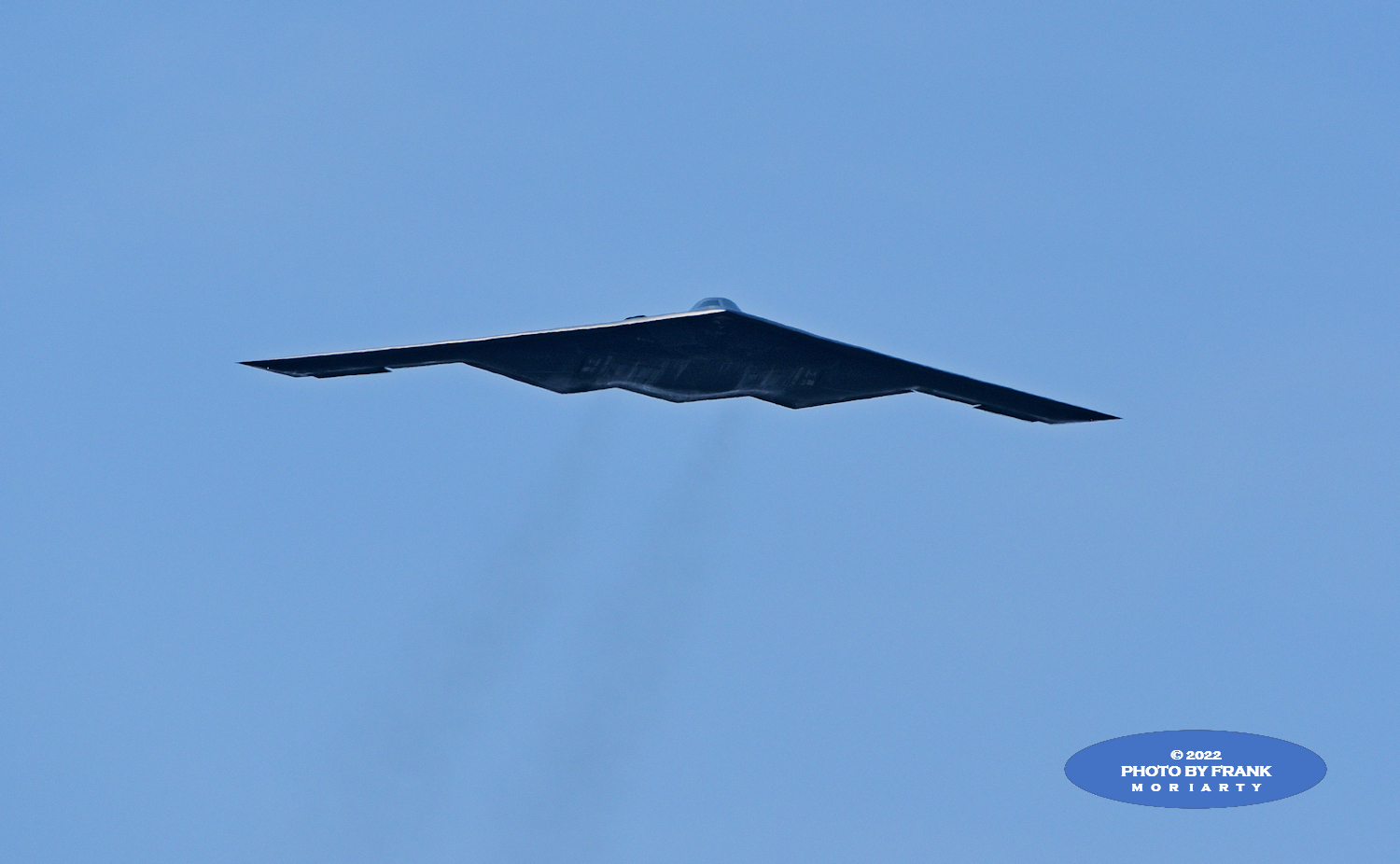
But if any single aircraft could be considered the star of the Dover show it’s the B-2 Spirit, popularly known as the Stealth Bomber.


The B-2 Spirit stealth bomber banks over Blue Angel 1 for a final pass at Thunder Over Dover on May 21, 2022.
 Photo: Frank Moriarty/Aerospace Perceptions


The appearance of a B-2 at air shows always generates excitement, and the three passes by this unique aircraft at “Thunder Over Dover” – present on May 21 only – drove a massive attendance turnout despite high temperatures well into the 90s.


The B-2 "Spirit of Nebraska" passes over the awestruck airshow crowd below. 
Photo: Frank Moriarty/Aerospace Perceptions

Built by Northrop Grumman, the B-2 first flew over 30 years ago, but despite being one of the most recognizable modern-day aircraft a noticeable hush fell over the crowd assembled at Dover AFB as the massive black boomerang made several passes along the flight line.

Despite the B-2’s popularity with the general populace, by the time the next airshow at Dover Air Force Base rolls around on the calendar it’s likely that a new generation of stealth will be coming into service.


Artist conception of the B-21 Raider ascending over Edwards Air Force Base. 
Image: U.S. Air Force rendering


The all-new B-21 Raider – also being built by Northrop Grumman – will be the result of a program to create the next-generation stealth bomber. Assembly of the first B-21 is nearing the stage where engine runs and taxi testing will lead to a first flight. The ground testing is now planned for later this year, with flight following in 2023. Initially flight testing was hoped for right about now on the calendar, but ironically on the day before the B-2 soared over Dover the Air Force announced this new testing timetable.

When the first B-21 is seen, the vision will look quite familiar at first glance. Retaining the B-2's overall shape, the Raider will have ample long-range capability even though it will be smaller than the B-2. Most important, though, the B-21 will boast new generations of what the Air Force refers to as “low-observable technology” – in another word, stealth.

Northrop Grumman has created website content for its B-21 Raider project, which you can visit here:

https://www.northropgrumman.com/what-we-do/air/b-21-raider/

Development logo of the B-21 Raider.

 Image: Northrop Grumman

Thursday, May 26, 2022

Raising Endeavour

One of the biggest thrills a space tourist can experience – not counting those tourists either financially well-off enough or lucky enough to find themselves actually launched into space – unfolds every few minutes at Kennedy Space Center Visitor Complex in Florida.

After watching a brief documentary, visitors are suddenly – and dramatically – presented with a sweeping view of the space shuttle orbiter Atlantis. As far as generating a goosebump-inducing experience, the revelation of Atlantis has been pretty much unrivaled.

Until now.

Next week groundbreaking will take place on a new home for Atlantis’ sister orbiter, Endeavour.


In 2021 the decommissioned space shuttle orbiters were dispatched across the United States for display. Here the first orbiter to fly, the test vehicle Enterprise, is seen en route to its new home in New York. Photo: Frank Moriarty/Aerospace Perceptions


In September 2012 the decommissioned and safed Endeavour arrived in California for transport to its new home, the California Science Center in Los Angeles. Since going on display shortly thereafter, Endeavour has been visited by thousands who have seen the orbiter horizontal in a temporary pavilion. But bigger plans are at last coming to fruition.

The Samuel Oschin Air and Space Center will be constructed adjacent to the California Science Center. The construction, estimated to take approximately three years, will result in a stunning presentation of Endeavour standing vertical as though ready for liftoff, mated to the last surviving space shuttle external tank and two solid rocket boosters (with, of course, propellants removed).


An artist conception of Endeavour's new home, the Samueal Oschin Air and Space Center. Image: Ron McPherson/ronmcpherson.com/


Having stood beneath Atlantis on the launch pad just before the STS-135 mission completed the space shuttle program, I can attest to the awe-inspiring nature of witnessing the full stack of the space shuttle system towering overhead. This new museum setting will be an appropriate depiction of one of mankind’s most amazing technical developments and will doubtless leave visitors with unforgettable memories.

Groundbreaking for the new space center is scheduled for June 1, with much additional information on Endeavour’s new home to come in the wake of the ceremony. Visits the California Science Center website to learn the latest:

https://californiasciencecenter.org

Tuesday, May 3, 2022

Sculpting the Skies with an F-22

With the first airshows of the 2022 season getting underway, I happened to take a look back at some of my work from 2021.

One of my favorite images pulled from the skies last year is this photograph of a Lockheed Martin F-22 Raptor as seen during a practice flight over New Jersey’s Millville Executive Airport. The image as a whole isn’t particularly noteworthy – F-22s frequently create their own cloud systems while maneuvering, which often translate into stunning photos. But the attraction here is in the details: an unusual exhaust pattern that is particularly striking.


Both photographs: Ⓒ 2022 Frank Moriarty/Aerospace Perceptions


From the heat and moisture content being displaced by the aircraft, the sky itself has taken on a three-dimensional appearance. It looks as though it’s a solid section, hovering in mid-air with a texture that could be felt – if you could only get your hands a few thousand feet up and not get burned as well!

Last year I had a half-dozen opportunities to photograph the F-22 in action, and look forward to further encounters in 2022.

Tuesday, April 26, 2022

More Rockets for Wallops

Rocket Lab’s two-stage Electron vehicle has not been covered here at Aerospace Perceptions before now, largely because to date the company’s launches have taken place on the opposite side of the globe from a complex in New Zealand. But in the relatively near future, that may change.

Last week Rocket Lab announced the first three scheduled launches from increasingly-busy Wallops Island, Virginia. The company’s Launch Complex 2 was built at Wallops’ Mid-Atlantic Regional Spaceport and has been awaiting its first Electron launch for three years, a delay largely generated by stringent safety initiatives in NASA software covering flight termination systems. But as soon as later this year an Electron will soar on a dedicated mission for Virginia satellite company HawkEye 360.


A Rocket Lab Electron heads uphill from the company’s first launch complex, located in New Zealand. Image: Rocket Lab USA


The payload for this initial mission launching from Virginia will be six radio-frequency-monitoring satellites, with nine more to be included in subsequent launches. As noted in a press release announcing these three missions, “HawkEye 360 provides commercial and government customers with insights that have helped to detect illegal fishing, poachers in national parks, GPS radio frequency interference along international borders, and emergency beacons in crisis situations.”


An artist conception of Rocket Lab’s Neutron, planned as a significant upgrade in launch capabilities. Image: Rocket Lab USA


Standing half as high as a space shuttle orbiter’s length, the Electron is unique in that it utilizes an electric pump configuration that feeds its Rutherford liquid propellant engines, built by Rocket Lab in Long Beach, California. By 2024 Rocket Lab hopes to implement launches of its under-development Neutron rocket from a second location on Wallops Island. This new vehicle will stand twice as tall as Electron.

Rocket Lab is also working toward enhancing its ability to recover and reuse rocket stages. One thing the company has already perfected is a certain comedic levity in naming its missions. The first three Electron launch attempts in New Zealand were christened “It’s a Test,” “Still Testing,” and “It’s Business Time.” Those were followed by missions including “Pics or It Didn’t Happen,” “Return to Sender,” and the upcoming “There and Back Again.”


For more on Rocket Lab visit: https://www.rocketlabusa.com/

For more on HawkEye 360 visit: https://www.he360.com/