You found the blog. Now find my books, articles, and music projects - LOUDFAST. Take a little trip: www.loudfast.net

Tuesday, May 3, 2022

Sculpting the Skies with an F-22

With the first airshows of the 2022 season getting underway, I happened to take a look back at some of my work from 2021.

One of my favorite images pulled from the skies last year is this photograph of a Lockheed Martin F-22 Raptor as seen during a practice flight over New Jersey’s Millville Executive Airport. The image as a whole isn’t particularly noteworthy – F-22s frequently create their own cloud systems while maneuvering, which often translate into stunning photos. But the attraction here is in the details: an unusual exhaust pattern that is particularly striking.


Both photographs: Ⓒ 2022 Frank Moriarty/Aerospace Perceptions


From the heat and moisture content being displaced by the aircraft, the sky itself has taken on a three-dimensional appearance. It looks as though it’s a solid section, hovering in mid-air with a texture that could be felt – if you could only get your hands a few thousand feet up and not get burned as well!

Last year I had a half-dozen opportunities to photograph the F-22 in action, and look forward to further encounters in 2022.

Tuesday, April 26, 2022

More Rockets for Wallops

Rocket Lab’s two-stage Electron vehicle has not been covered here at Aerospace Perceptions before now, largely because to date the company’s launches have taken place on the opposite side of the globe from a complex in New Zealand. But in the relatively near future, that may change.

Last week Rocket Lab announced the first three scheduled launches from increasingly-busy Wallops Island, Virginia. The company’s Launch Complex 2 was built at Wallops’ Mid-Atlantic Regional Spaceport and has been awaiting its first Electron launch for three years, a delay largely generated by stringent safety initiatives in NASA software covering flight termination systems. But as soon as later this year an Electron will soar on a dedicated mission for Virginia satellite company HawkEye 360.


A Rocket Lab Electron heads uphill from the company’s first launch complex, located in New Zealand. Image: Rocket Lab USA


The payload for this initial mission launching from Virginia will be six radio-frequency-monitoring satellites, with nine more to be included in subsequent launches. As noted in a press release announcing these three missions, “HawkEye 360 provides commercial and government customers with insights that have helped to detect illegal fishing, poachers in national parks, GPS radio frequency interference along international borders, and emergency beacons in crisis situations.”


An artist conception of Rocket Lab’s Neutron, planned as a significant upgrade in launch capabilities. Image: Rocket Lab USA


Standing half as high as a space shuttle orbiter’s length, the Electron is unique in that it utilizes an electric pump configuration that feeds its Rutherford liquid propellant engines, built by Rocket Lab in Long Beach, California. By 2024 Rocket Lab hopes to implement launches of its under-development Neutron rocket from a second location on Wallops Island. This new vehicle will stand twice as tall as Electron.

Rocket Lab is also working toward enhancing its ability to recover and reuse rocket stages. One thing the company has already perfected is a certain comedic levity in naming its missions. The first three Electron launch attempts in New Zealand were christened “It’s a Test,” “Still Testing,” and “It’s Business Time.” Those were followed by missions including “Pics or It Didn’t Happen,” “Return to Sender,” and the upcoming “There and Back Again.”


For more on Rocket Lab visit: https://www.rocketlabusa.com/

For more on HawkEye 360 visit: https://www.he360.com/

Thursday, April 21, 2022

The Cult of Personality

Elon Musk has been in the news a lot lately, which really isn’t news – or surprising. Whether it’s helping enable internet access to a besieged Ukrainian citizenry through his Starlink constellation system, or less altruistic activities like his hostile takeover attempt of Twitter, the richest man in the world injects his sphere of influence into many realms.

Perhaps Musk’s most high-profile endeavor, of course, is SpaceX. Currently – and successfully – cementing the idea of commercial space business activities in Earth orbit, SpaceX is also looking long-long-range at the colonization of Mars and eventual human exploration far beyond our Solar System neighbor. And from the beginning, SpaceX has proudly reflected its own spaceflight culture. Witness the decidedly different attitude on display during SpaceX launches, with lots of cheering and waving in a party-like atmosphere, compared to the staid liftoff proceedings witnessed within Kennedy Space Center’s Launch Control Center throughout the Apollo and Shuttle eras.


A featured image representing the content of a YouTube video.

Aside from such surface reflections, I’ve always been of a mind that when one space effort succeeds, they all succeed – if for no other reason than the illumination of success shines across the realm of space ventures as a whole. But it’s increasingly difficult to ignore a somewhat manic subset of SpaceX followers who eschew such a “one for all, all for one” philosophy.

This attitude was fully on display during NASA’s recent attempt to stage a full-dress rehearsal of its Space Launch System on Pad 39-B at Kennedy Space Center, complete with full system fueling. As might be expected with an entirely new assembly, numerous issues arose, to the extent that a roll-back to the Vehicle Assembly Building for problem resolution will delay launch plans until much later in the year. Each complication was derided by dozens of Twitter-based proponents of Musk’s Starship program – a program nowhere near as close to flight as NASA’s SLS. No matter – to them it’s Starship or nothing.

This fascination has led to seemingly-full-time social media “reporters” who plant themselves outside the SpaceX Starbase in Texas while trying to monetize hours-long web streams that usually show nothing more exciting than a pickup truck entering or exiting the Musk kingdom.

That’s just one symptom. I’ve seen SpaceX followers openly mocking the development efforts of other aerospace entities, with some even outright rooting for mission failures of rockets not bearing the correct logo. There’s nothing like holding aerospace programs to the standards of juvenile popularity contests.


Elon Musk and his partner in an on-again, off-again relationship, Grimes. A snapshot from the unavoidably glamorous life of the richest man in the world. Photo: thecut.com

Much of this frenzy is a strangely cult-like obsession with Elon Musk himself – which Musk certainly cultivates, consciously or not. It’s the aerospace edition of celebrity status circa 2022: how well known are you? In the increasingly weird global culture circling endlessly around influencers and personalities, being a celebrity is the very best thing you can do.

As a writer focused on the realm of aerospace, I will always be interested in Elon Musk and how he directs SpaceX. The interest in Elon as a person? Not so much. Like Apple’s own technical revolutionary, Steve Jobs, Musk may be brilliant - but I don’t think I’d want to spend much time around him.

Tuesday, April 5, 2022

Aviation Transformation Through imaginAviation

NASA operations, as of this writing, are struggling to deal with the inevitable new system problems that have arisen with the Space Launch System “wet test” - basically all aspects of launch pad operations (including fueling) save the launch itself.

A few weeks ago, though, much of the NASA community was embracing a much broader perspective through a program cleverly titled imaginAviation, under the auspices of NARI – the NASA Aeronautics Research Institute.


This three-day virtual event, which included the participation of many universities and other educational organizations, was based on imagination and how resulting visions can lead to the future transformation of aviation. Through more than 30 presentations, imaginAviation delved into topics and concepts ranging from environmental and emissions concerns to more esoteric topics such as Hyper-Spectral Communications for more robust and reliable air-to-ground communications.


NASA is continually involved in developing technical innovations in aircraft systems, a process that includes the utilization of this modified F/A-18. Photo: NASA


The tone for imaginAviation was set from the event’s keynote address, given by Dr. Kathryn Jablokow, a Program Director at National Science Foundation and Professor of Engineering Design and Mechanical Engineering at Penn State University. Dr. Jablokow stressed the idea of embracing multiple leading edges, noting, “Innovation makes people uncomfortable, but that’s not always a bad thing. It just means that people have this sense, this capacity to know when they’re getting close to an edge.

You can learn much more about ideas for the future of aviation and aeronautics as every presentation given across all three days of imaginAviation is available to watch by simply accessing the following link:

imaginAviation 2022 Presentations

Saturday, March 19, 2022

Color Statement

The March 18 launch of Russia’s Soyuz MS-21 – mentioned in an earlier Aerospace Perceptions update – has taken a turn for the surprising. After a fully nominal, brief two-orbit chase of the International Space Station, the Soyuz Korolyov spacecraft docked with the ISS. Hatches opened – and things took a turn toward the unexpected.

The three-man crew of the mission boarded the ISS wearing bright yellow and blue flight suits – the unmistakable colors of the Ukrainian flag.


Russian cosmonauts Sergey Korsakov, Oleg Artemyev and Denis Matveyev speak upon their arrival at the ISS, in a video broadcast by the Russian space agency. Video image: Roscosmos


Rampant speculation commenced. Was this the orbital equivalent of holding up a “No War” sign on Russian state television? How could the crew of the Soyuz stow away unofficial gear in the cramped confines of their vehicle? Was this a semi-official Roscosmos statement expressing anger over the financial impact Putin’s folly will have on the Russian space program? If Roscosmos was horrified by a crew protest, why did they allow video of the impertinence to stream out before the eyes of the world?

What was certain is that such colors have never been worn by any other Soyuz crew arriving at the ISS. When asked if the colors had special significance, mission commander Oleg Artemyev demurred.

“It became our turn to pick a color. But in fact, we had accumulated a lot of yellow material so we needed to use it. So that’s why we had to wear yellow,” he said.

Actions speak louder than words? Or perhaps an old truism says it best: a picture is worth a thousand words. 

Friday, March 18, 2022

Developments, Both Modest and (very) Large…

Just before noon EDT this morning, mission Soyuz MS-21 launched from the Russian spaceflight facility in Kazakhstan – the first manned spaceflight of 2022. The flight carries three Roscosmos cosmonauts bound for the International Space Station, the Russian spacecraft closing in on the ISS as I write these words. There is no need to revisit the strained US-Russia relations when it comes to space programs resulting from the needless invasion of Ukraine.


Bouncing back from a February mission failure, Astra successfully launched this flight from Kodiak Island in Alaska on March 15. Photo: Astra


Instead, let’s shed some light on another spaceflight venture this week that likely didn’t attract public attention. This launch took place in the relatively exotic setting of the Pacific Spaceport Complex on Kodiak Island in Alaska. Astra, the new spacecraft venture which suffered a mission failure earlier this year when a fairing failed to open properly after liftoff, this time enjoyed a successful flight to orbit with deployment of its small satellite payload a complete success. This venture opens the door for three planned Astra launches from Kennedy Space Center in months to come. More information on Astra and its planned ventures can be found here:

https://astra.com/


Some questioned when – if ever – the fully-stacked Artemis vehicle would appear ready for flight at Kennedy Space Center. The Artemis I vehicle began the final stage of its journey to the launch pad on March 17, as its eventual destination appeared in the skies overhead. Photo: Ben Cooper/ULA


Speaking of KSC in Florida, an hours-long process got underway late yesterday afternoon as the massive doors of the historic Vehicle Assembly Building slowly opened to reveal the fully-stacked Artemis I spacecraft system, ready to journey to Launch Complex 39B for final pre-flight testing. If all goes well, the massive vehicle – standing well over 300 feet tall – will climb into the skies later this year on an unmanned lunar test flight. Successful conclusion of this phase will put NASA’s space program within reach of a manned return to the moon – 50 years after the last Apollo mission, Apollo 17, completed on December 19, 1972.

Much more information on Artemis can be found here:

https://www.nasa.gov/artemisprogram

A gallery of Artemis travels from the VAB to LC39B on March 17 into the early morning of March 18 is here:

Friday, March 11, 2022

The War of the Words

Although the International Space Station (ISS) is just that – international in focus and components in orbit – by far the two biggest players to cement the success of this outpost in space are the United States and Russia.

In the wake of the final Space Shuttle mission - STS-135 in the summer of 2011 – United States manned missions to the ISS entered into a multi-year gap of dependency on Russian transport. On the surface it was a business arrangement, with the US reimbursing Russia for costs of carrying US astronauts to orbit. But the arrangement always depended on stability between the two superpowers, and minor events on Earth weren’t allowed to interfere with the ISS operations.


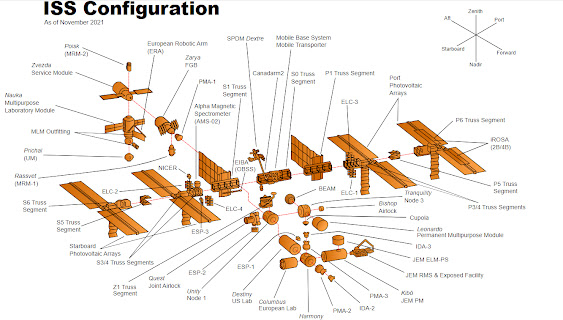
The configuration of the International Space Station. The Russians have threatened to take their pieces and go home.


Now, however, there is a major event, and the seismic implications of Russia’s brutal invasion of Ukraine have reverberated into the ISS orbit – just weeks after operation authorization of the ISS was extended to 2030. Now, the station’s future is in immediate doubt, let alone pondering eight years in the future.

Reflecting the belligerent attitude of Russia’s authoritarian leader Vladimir Putin, the head of the Russian space agency Roscosmos – Dmitry Rogozin – stated, “In this situation, we can no longer supply the U.S. with our rocket engines that are the best in the world. Let them fly on something else, like their brooms, or whatever.” This followed up on Rogozin remarks during the 2014 Russian invasion of Crimea when he suggested the US resort to the use of trampolines to reach orbit.


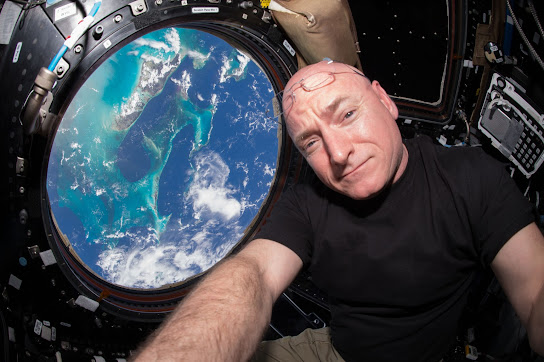
Scott Kelly during his year-long service aboard the ISS. When he returned, medical studies comparing Scotto to his twin brother Mark were conducted, seeking to understand the impact of long-term life in space.


Scott Kelly had heard enough. Kelly and his twin brother Mark made a lasting impact on NASA, the siblings aboard space shuttle flights as both pilots and commanders as well as logging time stationed at the ISS – Scott spending a year straight in orbit beginning seven years ago this month. As one does in 2022, Scott took to Twitter to counter the remarks of Rogozin, and the result was a spiteful feud between the two high-profile players in the realm of aerospace.

Just yesterday, on March 10, Rogozin threatened to break an agreement to land US astronaut Mark Vande Hei – himself approaching a full year in space aboard the ISS - along with two Russian cosmonauts next month. Effectively, Vande Hei would be left stranded on the ISS until the US could figure out the logistics to bring him home.

The backstory of the verbal conflict - one that points out how fragile the orbit of the ISS actually is when competing powers are supposed to act as partners - is detailed in this recent CBS News report:

https://www.cbsnews.com/news/russia-ukraine-scott-kelly-dmitry-rogozin/