You found the blog. Now find my books, articles, and music projects - LOUDFAST. Take a little trip: www.loudfast.net

Friday, February 8, 2013

Event Horizon 2013

Yes, technically “event horizon” is a spacetime boundary associated with gravitational pull around objects like black holes. But I’ve empowered myself to adapt it as a description of what’s on the horizon in the year to come, especially with regard to pending developments in manned U.S. spaceflight and exploration.
Last year was the first in recent memory in which no United States astronauts ascended to the heavens from a launch based in their home country. While we are in “the gap,” as this dependent-on-foreign-launch-resources period is informally known, anxious eyes in the U.S. are turned toward the progress of the CCDev (Commercial Crew Development) initiative.
Progress may seem to be slow in coming, but the four main CCDev players – Blue Origin, Boeing, Sierra Nevada, and SpaceX – all have an active year planned.


The SpaceX Falcon 9 rocket boosts the Dragon capsule into orbit in May, 2012.


Boasting what is likely the highest public profile, SpaceX successfully flew an unmanned supply mission to the International Space Station in 2012. But a manned flight increases the complexity of the vehicle. The company plans to conduct crew-escape testing – both on the ground and in powered flight at maximum aerodynamic pressure – later this year. And SpaceX’s second ISS supply mission could take place as soon as next month.
Blue Origin conducted its own such ground-based escape system test late last year, pushing a capsule mock-up over 2000 feet in altitude and safely landing the vehicle by parachute. The company, founded by Amazon.com billionaire Jeff Bezos, continues toward the goal of developing rocket-powered Vertical Takeoff and Vertical Landing (VTVL) vehicles for access to suborbital and orbital space. Their newest engine, designated the BE-3, is expected to be test fired in a matter of days. And though the company is not participating in the latest stage of the CCDev program as it applies specifically to manned spaceflight development, they are obviously a significant and well-funded presence.
Boeing continues to develop detailed systems for its CST-100 spacecraft, planned to reach orbit via the reliable Atlas V rocket.


A full-size mockup of the Sierra Nevada Dream Chaser.


Also eventually planned to be boosted spaceward via Atlas V is Sierra Nevada’s Dream Chaser. An unmanned glide test of the stubby-winged vehicle is planned to take place within weeks at Edwards Air Force Base.
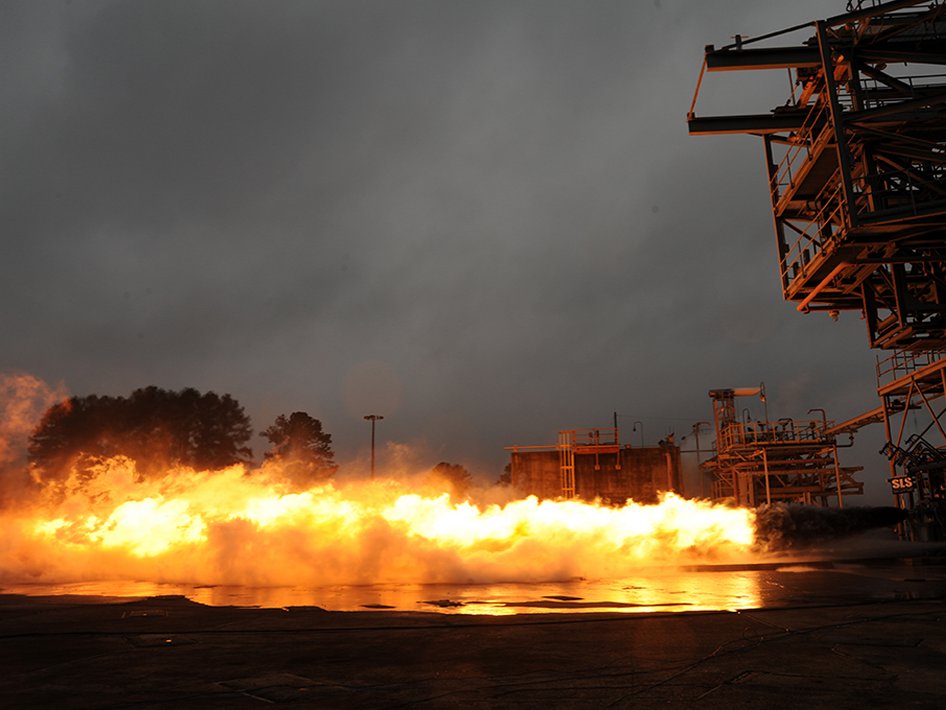
On Jan. 10, 2013, the Saturn V F-1 gas generator completed a 20-second hot-fire test. Engineers are completing a series of tests at NASA's Marshall Space Flight Center in Huntsville, Ala.


While these four corporate entities focus on the growing economic potential of manned commercial flight, manned space exploration remains NASA’s domain. In 2013, the space agency has been delving into a bit of “back to the future” research by studying the firing of Saturn V engine systems – the very technology used to carry NASA’s astronauts to the moon four decades ago. This is part of the foundation work for the Space Launch System, the planned future of manned exploration. This new generation spacecraft will require more thrust than is available in current boosters. Flight control tests of avionics for these new boosters are underway, with thrust control system tests taking place last week.
Finally, while not currently participating in the official manned flight efforts of CCDev, Orbital Sciences Corporation, planning the first launches of its Antares launch vehicle and Cygnus spacecraft, is an important presence. Orbital is currently focused on unmanned ISS supply missions, with a demonstration flight into orbit coming as soon as April. While SpaceX initiates its flights to the ISS from Florida, Orbital’s launch base is coastal Virginia’s Mid-Atlantic Regional Spaceport.
All in all, the horizon for 2013 boasts a number of events that should reflect positive spaceflight developments.

Return to action...

There are few things sadder on the Internet than a blog that’s fallen into inactivity, digital cobwebs hanging from that distant date in the past when the content was last updated…


Well, as Patti Smith exclaimed upon her return to the stage after breaking her neck in a fall: “Out of traction, back in action!”
My blog silence was not the result of a medical condition (fortunately!). Instead, I had the opportunity to focus on one area of my range of interests, and it demanded full attention. So I’ve spent much of the last nine months living in the past while working on the music of my band of the 1980s, Informed Sources. This effort ranged from mixing studio multitrack tapes and preparing for a commercial release to practicing and playing a one-off show in Philadelphia. And, of course, there was the creation of a Web site: www.FrankBlankMusic.com
But after all those weeks playing the roles of recording engineer, art director, sales manager, web developer, publicist, logistics coordinator – oh, and guitarist! – it’s time to end the hiatus and dust off these blogs.
Keyboard, computer, action!

Wednesday, April 25, 2012

Dawn Reveals


Four and a half years ago a Delta II rocket arced high over Florida, carrying what has proven to be one of the most fantastic unmanned explorers ever launched from our planet: Dawn.


September 27, 2007: As the sun rises, Dawn is carried aloft by a Delta II rocket at pad 17-B, Cape Canaveral Air Force Station.


Dawn’s mission is to explore the asteroid belt, with particular focus on two objects: the asteroid Vesta, and the so-called “minor planet” Ceres. Vesta’s dimensions are roughly 359 by 348 by 285 miles, while Ceres is much larger: nearly as big across as the state of Texas, and an object that may bear a weak atmosphere. Both objects are believed to have formed early in the inception of our solar system. Despite that similarity, the objects are vastly different entities – the very reason they were selected for exploration.


In this artist concept, Dawn is shown traveling among the asteroids. Each of the solar panels providing power measures 8 feet by 27 feet.


While Ceres will fall under Dawn’s gaze in 2015, the explorer arrived at Vesta in the middle of 2011, and has been hard at work ever since. On April 25, some of Dawn’s intriguing findings were presented by NASA’s Jet Propulsion Laboratory in Pasadena, CA.


NASA's Dawn spacecraft approaches orbit around the giant asteroid Vesta on July 24, 2011. This photo was taken from a distance of about 3,200 miles.


The surface of Vesta contains a wide variety of composition and patterns – including material that was at one time molten and beneath the asteroid’s surface. There are rocks apparently fused by collisions encountered in the asteroid’s travels, as well as smooth surface areas described by JPL scientists as “pond-like.”
Vesta is a frigid asteroid, with Dawn measuring temperatures ranging from minus 10 to minus 150 Fahrenheit – demonstrating how much of a role illumination from the sun can alter temperatures without atmospheric considerations.

 
A relatively new crater spreads approximately nine miles across the surface of Vesta. Boulders and other debris around the crater are believed to have originated deep beneath the asteroid’s surface, cast outward upon impact with the object that created this large surface scar.


So what’s next for Dawn? The explorer will continue work at Vesta, swooping to within 130 miles of the asteroid’s surface, until August 26. Then it’s off to Ceres, with arrival planned for February, 2015.
For more on Dawn and the incredible scientific discoveries being revealed by this vehicle, please visit NASA’s mission page at:  http://www.nasa.gov/dawn


Sunday, April 22, 2012

It Figures: Enterprise in Holding Pattern


UPDATE 4/24/2012:


NASA has announced the flight of Enterprise on board the NASA 905 Shuttle Carrier Aircraft is now scheduled for Friday morning, with the orbiter arriving in the New York area at approximately 10AM. Please refer to the link below for continuing updates.


UPDATE 4/23/2012:

NASA has announced the flight of Enterprise on board the NASA 905 Shuttle Carrier Aircraft is now scheduled for Wednesday morning, with the orbiter arriving in the New York area at approximately 10AM. Please visit the Intrepid Sea, Air and Space Museum web site for confirmation and scheduling announcements:


ORIGINAL POST CONTENT:


Going to see a space shuttle in action at Kennedy Space Center could be easier said than done during the program’s decades-long service life. Equipment failures during the countdown could lead to lengthy delays. Bad weather at the KSC Shuttle Landing Facility could lead to a last-minute diversion to a California landing.

Back in the days before everything was available for instant updating via the Internet, the main method of keeping up to date on shuttle launch preparations was to call a special number which allowed one to listen to a recording of George Diller reporting on the latest developments. I called this number so many times it’s permanently ingrained in my memory: 407-867-2525.

But in the years before cell phones were common you couldn’t just call the info line while cruising down I-95 toward Florida. I recall one depressing launch journey pit stop at South of the Border in South Carolina, where I happened to hear a news broadcast reporting the launch had been scrubbed due to a major component replacement that could take weeks. Reverse course.


Welcome to the moment of truth.


But perhaps nothing was worse was than the pit-in-the-stomach feeling as the countdown clock ticked down to 31 seconds - perhaps the most significant moment of each countdown, when the Ground Launch Sequencer would hand over control of the countdown to the shuttle’s onboard computers. Several times I stood in the Florida sun and watched that clock come to a halt just a half minute from launch. Sometimes the resulting delay was brief; other times, the launch was pushed back by a week or more. After all, changing out an Auxiliary Power Unit deep within the innards of an orbiter was no small task.

Even the charmed final flight of the shuttle program had its moment. As Atlantis waited on the pad, poised to begin the STS-135 mission, the clock crept toward the dreaded 31 second mark. Then it hit 30. Then it climbed back up to 31! Mercifully, the resulting delay was one of moments rather than days, and soon Atlantis was thundering uphill for one final time.

These thoughts all came to mind this week as Discovery made her way to a new home in the Washington D.C. area, and the original flight test orbiter Enterprise was prepared for a journey to New York.


Enterprise: ready to depart, just not yet.


I had planned on attending Discovery’s arrival, but family medical issues disrupted that plan. Instead, I made plans to cover the arrival of Enterprise in New York on April 23. I would be witnessing a significant reunion: the Shuttle Carrier Aircraft that will lift Enterprise into the skies one last time is the same plane that carried this first orbiter into the air for the very first atmospheric flight tests back in 1977.

And then, on April 20, came the Media Advisory from NASA:

WASHINGTON -- NASA's planned flight to New York City of space shuttle Enterprise atop the 747 Shuttle Carrier Aircraft (SCA) has been postponed until further notice due to an unfavorable weather forecast for Monday, April 23.


File this under "unfavorable conditions."


Somehow, it seems appropriate. This will likely be the last time I will ever see a space shuttle in flight, even if it is attached to a modified Boeing 747. A shuttle-related delay? I’d expect nothing less. But I also know that - as always - the wait will be worth it.


Sunday, March 25, 2012

Discovering Discovery

The week of April 16th, there will be just one destination for followers of spaceflight and aviation in general: Washington, D.C.  Why? The arrival and public display debut of the first of the retired American space shuttle orbiters, Discovery.

Discovery will take to the skies for the final time on April 17, winging her way north from Kennedy Space Center aboard one of the two modified Boeing 747s that previously carried her home to Florida from landings at the dry lake bed at Edwards Air Force base in California.


Although there will be no public access to Discovery’s arrival at Dulles International Airport in the mid-morning hours of the 17th, it’s likely that spotting the two aircraft in flight was not be that hard. And for those not able to reach the nation’s capital, details of Web broadcasts covering the landing should be announced in the near future.

Over the next two days following the orbiter’s arrival, the huge spacecraft will be de-mated from the 747 and prepared for towing to her new home, the National Air and Space Museum’s Steven F. Udvar-Hazy Center, located near Dulles. On April 19, a public celebration will commemorate the transfer of responsibility for Discovery’s caretaking from NASA to the museum, where visitors will see not only the new arrival but also the early flight prototype orbiter Enterprise, which just days later will head north on her own journey to a new home at the Intrepid Sea, Air & Space Museum in New York.


Details on the National Air and Space Museum “Welcome Discovery” events can be found here: http://www.airandspace.si.edu/collections/discovery/

Discovery will always have special meaning for me. She the first space shuttle I saw head “uphill” into orbit, carrying the Hubble Space Telescope into space on April 24, 1990. But more recently, in June 2011, I was invited to visit and board Discovery as preparations got underway for her new, post-retirement life.

Here’s a look at Discovery within one of the Orbiter Processing Facility buildings at Kennedy Space Center.


Above, the entrance to the Orbiter Processing Facility where much of the museum preparation work took place. For years, the OPF buildings had a far different charge: to prepare the orbiters for flight into space.


The OPF environs are cramped, with no location offering a panoramic view of the entire orbiter. Dead ahead, one of Discovery's landing gear.


Discovery's nose, with the on-orbit maneuvering systems taken out to remove harmful propellants.


The intricate patchwork of protective tiles guarding the orbiter's underside.


A look into the payload bay. Using the remarkable Canadarm robotic arm seen in the foreground, the Hubble Space Telescope - and many other payloads over the years - were deployed into orbit.


A view into the mounting areas of the three Space Shuttle Main Engines, the liquid-fueled engines that worked with the Solid Rocket Boosters to shove Discovery "uphill" into space.


On board Discovery, this air lock provides access to the payload bay from the orbiter's mid-deck.


Passing through the mid-deck airlock yields this amazing view of the payload bay.


Discovery's upper flight deck, with the commander's consoles on the left and the mission pilot's on the right. There is an area of just a few feet from the back of the seats to the rear bulkhead of the flight deck. Spacious it is not.


Of all the places that I ever thought I would visit, this is one location I never saw myself. To be on board what is quite likely the most complex vehicle ever built by mankind was a tremendous experience. It will be well worth your time to take a trip to the National Air and Space Museum to see Discovery up close for yourself.


Wednesday, February 29, 2012

We are the Explorers...


Sometimes you just need inspiration.

It's too easy to become bogged down in the world of hardware, calculation, budgets. Too easy to lose sight of the wonder of what has been accomplished and what lies ahead.

Need a reminder? I did.

Courtesy of NASA, it's right here... Everything you need in just over 2.5 minutes!


Friday, February 10, 2012

We've got to get in to get out...

The line above from a Genesis song on The Lamb Lies Down on Broadway could be describing an amazing project that resulted in a tremendous scientific breakthrough several days ago: tunneling into Earth to discover things about the outer regions of our solar system.


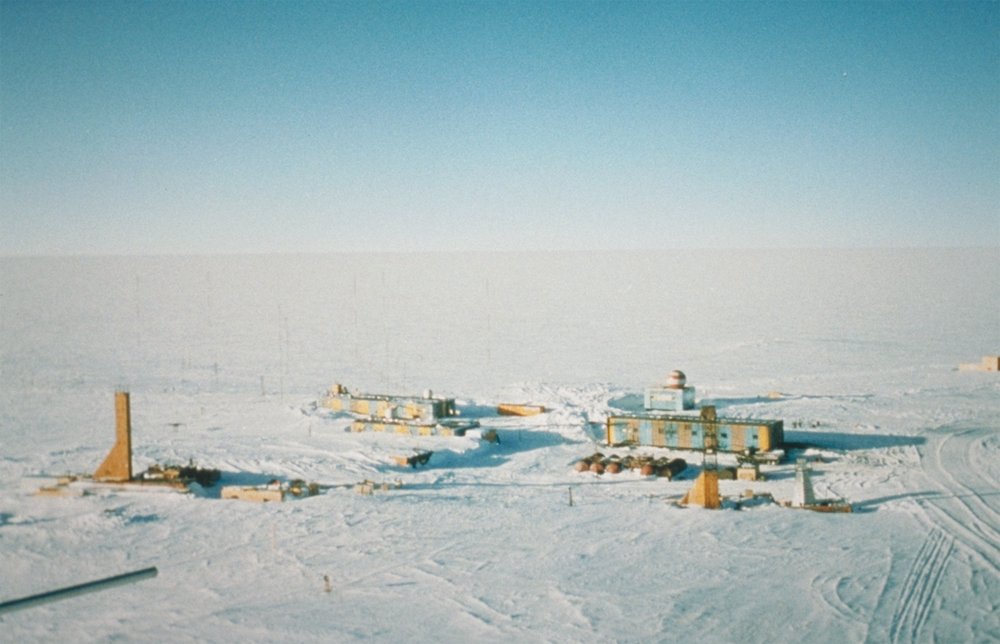
An aerial view of the remote Vostok Research Station.


The Vostok Research Station, established in 1957, is located in one of the most forbidding locations on Earth, isolated on the East Antarctic ice sheet. The coldest temperature ever recorded on our planet was logged there in July 1983: minus 128.6 degrees.

What does this have to do with space exploration? The work being done here may pay off with clues to the possibility of life existing on the moons of Jupiter.


Diagram illustrating the colossal Vostok effort.


For ten years, scientists and researchers drilled down tremendous depths, through two miles of solid ice. Their goal? To reach Lake Vostok, a huge, subterranean body of water deep below the Antarctic. On Sunday, February 5, they broke through, finally confirming that they had reached the massive underground lake, which is comparable in size to Lake Ontario.


A good time to go out and celebrate! Unfortunately, options are limited...


Now things get interesting: despite the fact that Lake Vostok's waters have been sealed off from the surface for millions and millions and years, debate rages over whether life in some form still exists in the waters. It is believed that gravitational forces cause high and low tide conditions, despite the fact that the sealed lake is under pressure. The motion, theoretically, provides sufficient circulation for the survival of ancient microorganisms. Similar conditions may one day lead to the discovery of life in water on the icy, frigid moons of Jupiter.

More on the project and the successful breakthrough to the waters of Lake Vostok:

http://www.nytimes.com/2012/02/09/world/europe/russian-scientists-bore-into-ancient-antarctic-lake.html