You found the blog. Now find my books, articles, and music projects - LOUDFAST. Take a little trip: www.loudfast.net

Thursday, March 10, 2022

Ice, Ice, Baby?

Ever since mankind began lobbing rockets up and out of our atmosphere, ice has been known to occasionally play havoc with images in still photos, film, and video. From time to time, ice flaking or falling away from space-bound vehicles has masqueraded as any number of objects – even leading to occasional speculation that what was being seen might be romantically extraterrestrial as opposed to the commonly frozen.

The latest such conundrum comes from a SpaceX launch yesterday, as Falcon 9 booster B1052 successfully lifted off from Florida on a Starlink satellite deployment mission. Everything was routine until sharp-eyed viewers noticed something nearly seven minutes into the flight, as the booster – now separated from its payload – was orienting itself for landing and recovery.
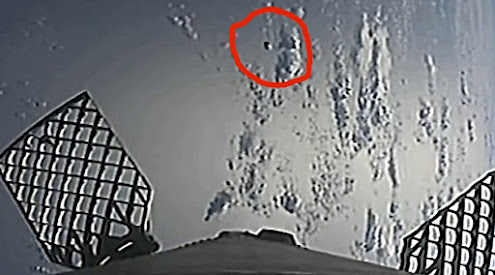
SpaceX Falcon 9 booster B1052 was preparing for post-launch descent yesterday when the circled object made its mysterious appearance.

Via a camera mounted on the booster, for several seconds something is seen moving vertically from the bottom of the screen to the top and slightly right to left. The object – dare I stick my neck out and not refer to it as ice – appears to be tumbling as it progresses, and before moving out of the frame reflects light. Although to be honest, for some object in space to be captured in the video for that amount of time, it would most likely have to originate from the SpaceX booster itself. Or did it?

You can see the video for yourself – and read the spirited debate or come up with your own explanation – by using the hashtag #B1052 on Twitter, or follow this direct link:

https://twitter.com/VickiCocks15/status/1501871833406181380

And if you figure it all out, let me know!

Friday, March 4, 2022

Mriya: Confirmation

Over the last few days – appearing as a footnote to the endless stories of death and destruction in Ukraine – several outlets questioned whether the massive Antonov An-225 known as Mriya had actually been destroyed in combat at Hostomel Airport outside Kyiv. Sadly, those questions have now been fully answered.

Video footage from “Channel One” retweeted by Turkish defense industry news platform SavunmaSanayiST.com provides evidence of the aircraft’s destruction.


Again, as I stated in my original post about the An-225’s fate: In no way am I equating the destruction of this flying machine with the loss of life and human suffering being imposed upon the world by Vladmir Putin’s dastardly and warped visions for power and control. This post is just a hope that an incredible vehicle will be remembered for the unique airplane it was.

Sunday, February 27, 2022

A Bitter End to the Legend of Mriya

It was the heaviest aircraft ever built, with a wingspan just ten feet shy of a football field’s length. It was almost equally as long. And now multiple reports from Ukraine indicate with growing certainty that the lone Antonov An-225 Mriya in existence was destroyed in its hanger at Hostomel Airport outside Kyiv, as Russian forces conduct the senseless invasion of their neighboring country.


The An-225 in its first days of glory, carrying a Buran prototype across the skies.


Designed by the Antonov Design Bureau in the Unkrainian Socialist Soviet Republic in the later years of the Soviet Union, the plan for the An-225 was for it to play a crucial role in the space program. Its capabilities were such that it could haul massive Energia rocket boosters as well as the orbiters of the Buran program, the ultimately failed attempt by the Soviet Union to mimic the United States’ NASA space shuttle fleet.


Revitalized as a powerful commercial cargo aircraft in more recent years, Mriya rising into the skies was an unforgettable sight.


After its military duties concluded, the aircraft languished for eight years until it began a new life as a commercial aircraft capable of moving payloads no other aircraft could match. Known as Mriya, the An-225 nearly had a sister ship. Largely assembled in the 2000s, the second aircraft was never completed, leaving Mriya to rule the cargo skies.


Runway width and clearance was the first crucial consideration when it came to planning ventures for the An-225.


Like the remains of the Buran program, which now are shamefully rotting away in remote facilities in Russia ( Visiting Buran Relics ), the Antonov An-225 was a relic of a different time – yet still a fully functional contributor to the world of aviation. Aircraft fans kept close tabs on this plane’s adventures, seeking a chance to witness the An-225 in flight. It’s certainly a sight I wish I could have witnessed myself.


In no way am I equating the destruction of this flying machine with the loss of life and human suffering being imposed upon the world by Vladmir Putin’s dastardly and warped visions for power and control. This post is just a hope that an incredible vehicle will be remembered for the unique airplane it was.

Thursday, February 24, 2022

Back to Work

Last week’s show is over, with Elon Musk’s SpaceX Starship system prototype now de-stacked in Texas. Yet in the wake of his high-profile briefing at the Starbase facility, Musk was continuing to bring attention his way by apparently sniping dismissively at spaceflight rivals on Twitter, issuing this gem on February 18:

SpaceX’s goal is to make life multiplanetary, whereas their goal is to put a handful of satellites in orbit

SpaceX certainly is the big commercial aerospace player with flashy talk of lunar stations and colonies on Mars, to be made possible by rockets carrying dozens of passengers – the Starship program being a very public work in progress. But right now, the unflashy work of supporting space operations goes on largely unheralded by the media or public.

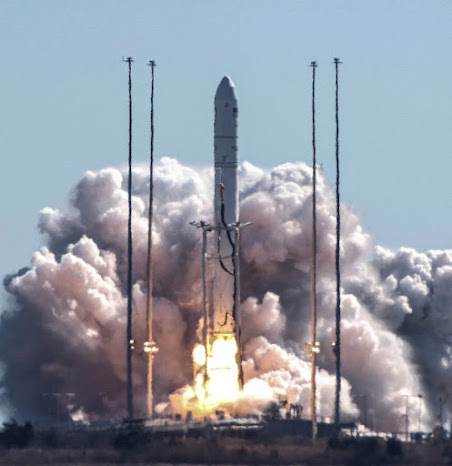
A Cygnus/Antares stack heads uphill from Wallops Flight Facility on February 19, 2022. Photo: Northrop Grumman 

The day after Musk’s tweet, an Antares rocket launched to the International Space Station, smoothly and on schedule from NASA's Wallops Flight Facility in coastal Virginia. The Cygnus vehicle placed into orbit was carrying well over 8000 pounds of equipment, experiments, food, and other important supplies. Safely docked at ISS early on February 21, offloading of the varied cargo soon was underway.

There seems to be a growing tendency to take for granted the meat-and-potatoes missions that make up almost all launch calendars - even those of SpaceX, Musk’s tweets notwithstanding. But no mission is ever routine until it concludes successfully. That’s a truth that will remain a constant, no matter how seemingly mundane or unglamorous the payload.

Saturday, February 19, 2022

Stacking and Speaking Starship


A screen image of the Starship stacking operation in Texas live streamed by NASASpaceFlight.com


Just over one week ago SpaceX successfully stacked their massive Starship system at their operations base in Texas, for the first time using their new “chopsticks” methodology – grabbing a prototype of the Starship crew vehicle and raising it to the top of a huge Super Heavy booster. By contrast, NASA continues to perform hoisting within their gigantic Vehicle Assembly Building at Kennedy Space Center, as they have recently done with what will be the first Artemis assembly of the Space Launch System/Orion spacecraft. In a few months Artemis will undertake an unmanned mission to the moon before crew operations get underway within a year.


As for Starship? The ultimate goal is a large crew bound for Mars. But last week speculation ran rampant about exactly what visions SpaceX head Elon Musk might reveal at a scheduled media gathering and worldwide streaming event in the immediate wake of the Starship stacking. The thought was that if Elon said anything hard to believe, we may be the ones that need to rethink that belief. After all, the amount of progress SpaceX has made has been stunning. Ten years ago, I toured what was the humble SpaceX facilities at Kennedy Space Center and Cape Canaveral. To see the visions presented back then come to fruition has been beyond impressive. And there are plenty of near-future developments in store. For example, those Starship chopsticks aren’t just for lifting – the plan is to use them to snatch a returning booster out of the sky. Impossible? We’ll see about that…


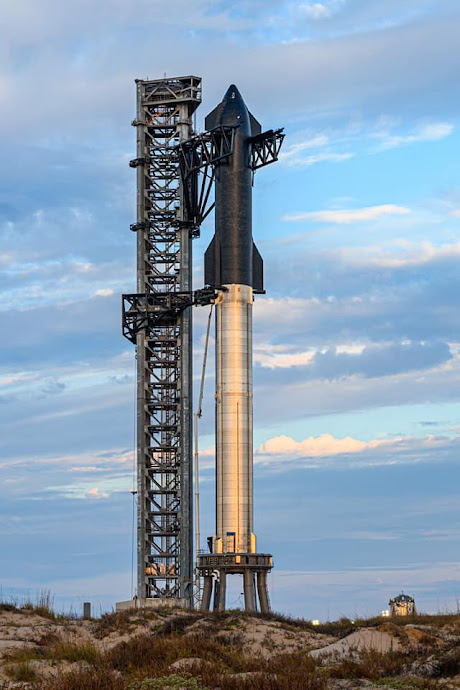
The fully-stacked Starship system prototype, beautifully captured by photographer John Kraus ( @johnkrausphotos ) the morning after the stacking operation. The operation had begun the night before as the clock neared midnight, taking place in darkness. 

In the aftermath of Musk’s actual remarks at his showy evening Starship status gathering, some observers have expressed disappointment. There was no bold announcement of imminent breakthroughs, just a report on concrete progress. But the very fact that a Starship prototype loomed in the skies above a place now known as Starbase, Texas… Well, that was a statement in itself.


Friday, February 18, 2022

The Missing Link(s)


While investigating a potential re-platforming of the Aerospace Perceptions content repository, an extraction process inadvertently removed several dozen posts from the middle years of AP’s existence since its inception in 2011. The content and images are not lost (I worked in IT far too long to let that happen) but they are not in the accessible content hierarchy here. At some point I’ll initiate the effort to reposition it all back into the date-sorted format on this site; for now, though, let’s move on with AP posts into the future.

Bottom line: mind the gap!


Friday, February 11, 2022

Increments in Stealth


Originally published: August 2017


This weekend, I had the opportunity to witness several passes over Delaware's Dover Air Force Base made by a B-2 Spirit, more commonly known as the Stealth Bomber. The aircraft's presence was certainly a highlight of the Thunder Over Dover airshow.


The Northrop Grumman B-2 "Spirit of California" over Delaware, August 26, 2017.


I have always been fascinated by the realm of secret aircraft development, to the extent of climbing Nevada's Tikaboo Peak so I could see the notorious Area 51 with my own eyes – while creating a promotional video for my band at the time, Third Stone Invasion. I've also read a number of books about the famed Lockheed Skunk Works, where revolutionary planes like the SR-71 Blackbird and F-117 Nighthawk were developed in need-to-know secrecy.

Commemorative artwork depicting the top-secret glories of the Skunk Works' past.


The problem with those books is that they all tend to feature the radical angles of the F-117 on their covers. Understandable, as the F-117 stealth attack aircraft is one of the wildest-looking planes to ever fly. But state of the art? Consider that the F-117 has been retired from service for almost a decade.

As the ominous B-2 flew over my head the other day, I couldn't help but wonder, “What's next?” After all, this specific aircraft was the Spirit of California, the second B-2 to enter into service. That happened almost 25 years ago.

It had been some time since I'd looked into developments in this realm, so spurred on by my B-2 encounter I wanted to find out if there was speculation about military aviation being on the verge of wild, radically intimidating new designs.

Screen grab from a 2014 promotional video created by Lockheed to call attention to Skunk Works activities.


What I found was evidence of highly-advanced but incremental progress. The emergence of the F-117 after growing familiar with the planes of the 1950s, 60s, and 70s was startling. But a similar aesthetic shock does not seem to be in store. Lockheed, now publicly promoting its Skunk Works with its very own website - Click here to visit Skunk Works website - presents a video in which the concept of “collaborative systems” is stressed, combining manned and unmanned aircraft. Several of the concepts seen in the video call to mind the spooky shape of the B-2.

Artist conception of the B-21 Raider, with the "21" reflecting the 21st Century.


As for the B-2 itself, its successor is to be the B-21 Raider, both aircraft built by Northrop Grumman. The B-21 is expected to enter into service in 2025, while B-2s will continue to be flown well beyond that date.

Surely there are amazing technologies lurking beneath the skin of the B-21, but what's most interesting on the surface is how much it looks like the B-2. It seems that in this case, they got it right the first time.