This is the legacy site of Aerospace Perceptions, and is no longer updated.
Aerospace Perceptions has a new home with some great new features.
The new website is easily reached via AerospacePerceptions.com
I hope to see you there!


This is the legacy site of Aerospace Perceptions, and is no longer updated.
Aerospace Perceptions has a new home with some great new features.
The new website is easily reached via AerospacePerceptions.com
I hope to see you there!

In the winter-spring lull before the 2024 air show season
ramps up, Aerospace Perceptions is taking advantage of the downtime for a
complete retooling of the website.
As a former IT system architect, I have teamed up with senior
developer Travis Finlayson in pursuit of a vastly improved Aerospace
Perceptions experience.

Under the covers, the website will reside on a completely different
technical foundation, improving performance and reliability.
From a user experience perspective, the website will have a
fresh, cleaner interface. It will be a more conducive home to new aerospace
content, AP posts of the past, and an all-new gallery feature.
Stay tuned – the Aerospace Perceptions re-launch is just over the horizon!
With Aerospace Perceptions delving into the realms of both aviation and spaceflight, Sierra Space have hit the sweet spot in interest with their Dream Chaser program – a lifting-body spaceplane. But it’s been a long time coming.
How long? It reminds me of when I was writing a book about early
aerodynamic programs in motorsports. I went to interview several
aerodynamicists at Chrysler’s headquarters who had previously worked at the company’s
missile division in Alabama. When I arrived, I had to cool my heels because the
wind tunnel was hosting several models that needed to be hidden – vehicles planned
for five to ten years in the future.

The initial Dream Chaser concept, with a certain other well-known spaceplane in the background. Image: Sierra Space
When I covered STS-135 in 2011 – the final flight of the Space
Shuttle orbiter Atlantis and the conclusion of that entire program – Sierra Nevada
Corporation had a presence at Kennedy Space Center’s media operations with an
early concept design of their Dream Chaser spaceplane. The spin-off Sierra
Space Corporation was formed in 2021, and here we are now, just over a dozen years from the
STS-135 mission. Dream Chaser is finally on the horizon of an actual mission.

An operation conception of Tenacity in orbital action. Image: Sierra Space
To get to this point it took tenacity, and that’s exactly
the name Sierra Space chose for its first operational spaceplane, following up
on engineering test vehicles. Tenacity - officially designated DC-101
Tenacity – was completed in November 2023.

Tenacity nearing completion of the vehicle construction
phase. Photo: Sierra Space
Tenacity’s first voyage will be one that is earthbound, from
Sierra Space’s Colorado headquarters to Ohio’s Neil A. Armstrong Test Facility.
There the vehicle will undergo a series of environmental tests to prove its space-worthiness.
If all goes well, Tenacity will then initiate Dream Chaser
space operations later this year as a cargo vehicle, supplying the International
Space Station. Launched into orbit via a Vulcan Centaur rocket developed by
United Launch Alliance, Tenacity will then return to earth upon completion of
the ISS resupply, making use of its unique design to land on a conventional
runway.

The planned crew configuration of a Dream Chaser Space System vehicle. The latest designs depict this DC-200 series spacecraft without the front windows seem in earlier conceptions. Image: Sierra Space
The planned near-future flight to the ISS will be the first outing of Sierra
Space’s Dream Chaser Cargo System; crewed vehicles are planned to follow under
the Dream Chaser Space System program, beginning in 2025.
For more on Sierra Space’s Dream Chaser efforts, please
visit:
Delaware State Police helicopters N1SP and N2SP are a frequent presence in the vicinity of Aerospace Perceptions headquarters in New Castle, Delaware. Within the last week they’ve been seen here completing a medical evacuation two blocks away from AP HQ and providing security and surveillance for the arrival of President Joe Biden at New Castle’s airport last night.

N1SP in the late autumn skies above New Castle, Delaware. Photo: Frank Moriarty / Aerospace Perceptions
This morning, N1SP was the star of the show at the Good Will
Fire Company’s annual open house in New Castle, arriving in a cloud of autumn
leaves launched back into the sky by the rotors of the descending aircraft.
Thanks to these aviators and all the others across the
nation who provide critical services to the population of our diverse country.
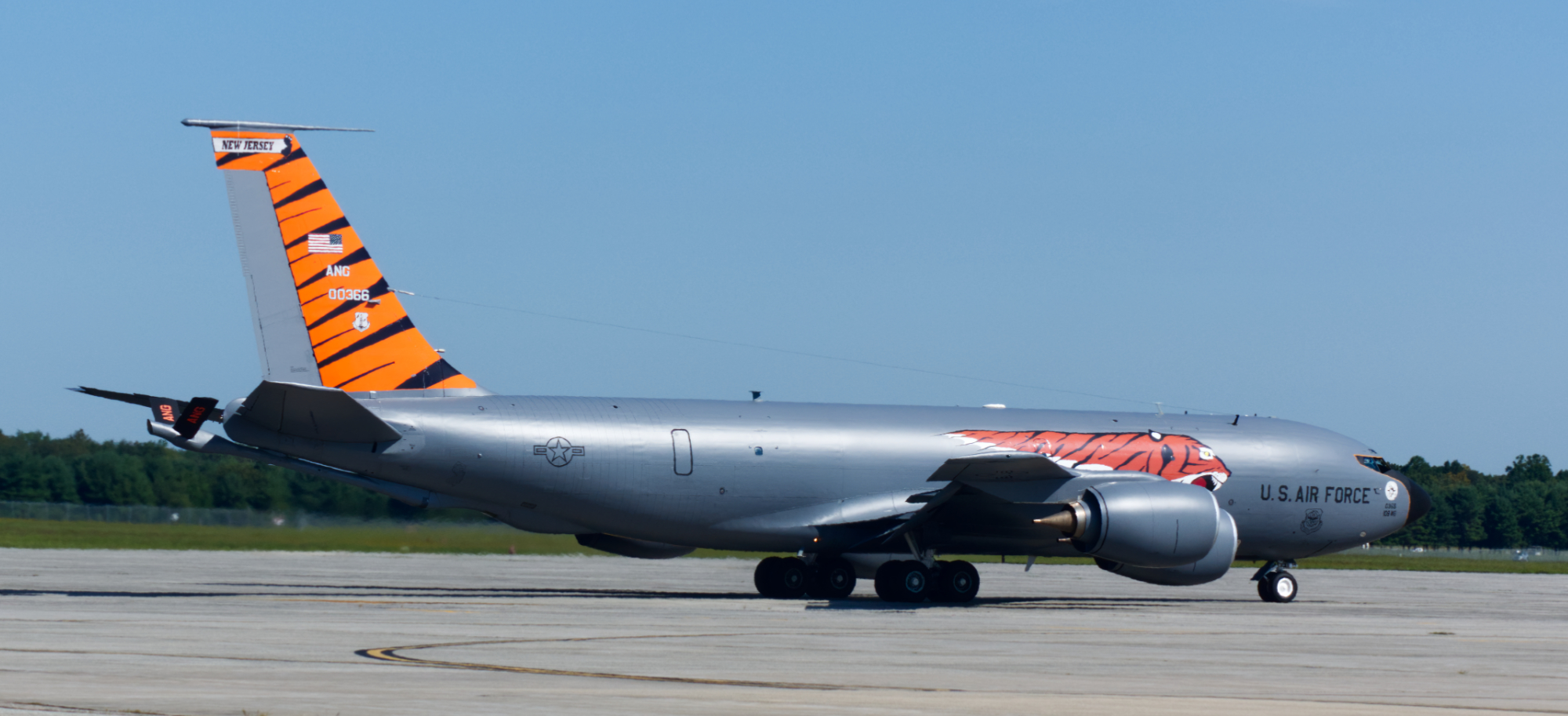
Country music legend Buck Owens had a smash hit in 1964 with the song “I’ve Got a Tiger by the Tail.” That track always sprung to mind when I would see one of the United States Air Force’s most striking aircraft, the KC-135R Stratotanker designated 60-0366, clad in its bright tiger livery.

It was just four years before Owens topped the music charts
when this Stratotanker first flew, freshly constructed by Boeing Military
Airplanes in 1960
Nearly three decades
ago, 60-0366 was assigned to aerial refueling duty with the 108th
Wing at McGuire Air Force base, now a key component of Joint Base
McGuire-Dix-Lakehurst. Over the years since, one thing remained consistent:
home base for this 135 was always New Jersey. Until last week.
A strategic decision has been made which sees the remaining KC-135 workhorse tankers that had been based at McGuire now reassigned to other facilities. But seeing these aircraft go is far more than just a reallocation of military resources. Air crews and maintainers have bonded with these legendary planes, and their departure demanded a ceremony in recognition of their service.
That gathering took place last week in a hangar at McGuire.
And just outside, the final KC-135R stood ready to depart for a new home in
Maine.

This particular 135 – tail number 00366 – is one of the most
distinctive of USAF aircraft, with its bright orange-and-black tiger livery
honoring early aviator Captain Hobey Baker’s Princeton University heritage.
Baker, a test pilot in the years immediately following his distinguished
service in the first world war, was killed in a crash in 1918. Princeton’s
association with tiger graphics carried over onto this KC-135 in Baker’s
memory.

The guests assembled for the ceremony ranged from those on
hand to welcome 00366 when it first arrived at McGuire to those who have most
recently flown and maintained this aircraft. The walls of the hangar were
adorned with memorabilia and artefacts heralding the 108th Wing and
its colorful association with the mascot of Hobey Baker's alma mater.

Following the traditional Presentation of Colors, National
Anthem, and invocation, Senior Master Sergeant Donald Woods touched on many of
the facts that make up tail 60-0366’s incredible history. This KC-135 was the
408th Stratotanker to be built, and had flown in service to the USAF
for more than four decades before it arrived at McGuire and was placed into the
care of the 108th Wing in October 2007. Involved in numerous global
operations since that time, this aircraft has logged over 4500 flight hours.
Woods offered a fitting summary of the KC-135’s career: “To
this aircraft I say, job well done!”
Brigadier General Patrick Kenndey – who served as commander
of the New Jersey Air National Guard – then took the stage to introduce the
final flight crew and maintainers for this auspicious occasion, followed by an
additional appreciation for this aircraft and those who have served and do
serve in the 108th Wing.

Major General (Ret.) James McIntosh was then introduced as keynote
speaker, reflecting on his time as commander at McGuire Air Force Base – a
position that only came after more than 100 combat missions as KC-135 navigator
during the Vietnam conflict and more than 6,400 flying hours total.
“I was privileged to be a crew member of the crew that
brought the first KC-135 into McGuire,” McIntosh noted of the Stratotanker’s debut
New Jersey arrival 32 years ago. “It’s my honor to be here today as we say
goodbye to this airplane.”

Following a video commemorating the 108th Wing
and the KC-135, members of the 108th Fabrication Section unveiled a
stunning replica of KC-135R 60-0366 that will ensure memories are permanently
reflected through this work of art.

With the indoor ceremony complete, the hundreds of people on
hand emerged into bright sunshine and the sound of 00366, fired up and ready to
begin its final flight from McGuire. Forming a long, orderly line to the right
of the KC-135, the witnesses to this occasion offered final salutes as the huge
aircraft began to taxi toward its takeoff. Once airborne, the majestic
Stratotanker circled the base and made a final pass at low altitude in
farewell.
The 108th Wing will now begin a transition to the
newer Boeing KC-46 Pegasus tanker, even as talk heats up in the aerospace realm
over concepts like autonomous aerial refueling. But those are visions for the
future; for now, it’s entirely appropriate to focus on all those years of a job
well done thanks to the enduring KC-135.


Where man goes, waste follows. Call it garbage, trash, refuse, litter, rubbish – or even space junk.
Space junk usually becomes a hot topic only when there is
some large object that finally must yield to gravity with its final landing
spot largely unknown. Although the likelihood of a water impact is greatest,
anxious eyes turn to the skies just in case.

In reality, though, such high-profile encounters between
worn-out satellites and our home planet are merely the tip of the proverbial
iceberg. According to NASA’s Orbital Debris Program Office, located at Johnson
Space Center in Houston, Texas, there are upwards of 500,000 marble-sized
objects circulating in orbit, joined by millions of objects 1mm or smaller.
In early July The Washington Post wrote about the US Space
Force’s quest to establish a military identity and identify what concrete
responsibilities this newest branch of the Armed Forces of the United States
will have. The article referred to low earth orbit tests of satellite
destruction that have already been conducted by Russia and China, as well as
speculation that any Chinese action against Taiwan will be predicated on the
destruction of numerous satellites to hamper the defense of Taiwan by its own
forces and allies.
Of course, any destruction of satellites is an act of
creation: the generation of more space junk in low earth orbit.

Putting aside the topic of satellite warfare, what to do
about the problem that already exists? As might be expected with such a complex
issue, opinions vary widely. There have been many proposals and ideas, some translated
into proof-of-concept missions like Surrey Space Centre’s RemoveDEBRIS and
Japanese company Astroscale’s ELSA-d.
At the moment, one of the most promising efforts taking
concrete steps to mitigate the danger of debris in orbit is the ESA (European
Space Agency) alliance with the Swiss company ClearSpace SA. They intend to
target a VESPA payload adapter, a refrigerator-sized object that has remained
in orbit since playing a role in a 2013 ESA Vega mission. Scheduled for 2026, the
ClearSpace-1 mission will attempt to rendezvous with VESPA, capture the object,
and guide it to a harmless destruction upon reentry to our atmosphere.

Ironically – and fully indicative of the urgency of
ClearSpace’s mission - just a month ago the VESPA target was itself hit by a small piece space junk, the resulting debris from the collision adding to the amount of trackable objects
already in orbit. ClearSpace is analyzing what impact the collision may have on
its planned mission to capture and safely deorbit VESPA.
Although ClearSpace remains for now an imposing distance
away from being able to reduce the threat of the hundreds of thousands of small
objects crowding space, the start of ClearSpace-1 is far better than no action
at all.
For more information, please visit:
ClearSpace: https://clearspace.today/
NASA Orbital Debris Program Office: https://www.orbitaldebris.jsc.nasa.gov/
In 1952, the Douglas Aircraft Company began work on a project that, six years later, had morphed into the DC-8, a four-engine jetliner that helped revolutionize air travel. Taking to the skies for the first time on May 30, 1958, the DC-8 would go on to remain in production for nearly 15 years, with more than 500 of the aircraft constructed.
One specific DC-8-72 was purchased and put into service in
1969 by Alitalia, before Braniff purchased this plane and implemented it as a
member of its fleet from 1979 to 1986. At that point, this aircraft was
repurposed from passengers to science when NASA took possession of it. The aerospace
and sciences agency began outfitting it with entirely new capabilities, turning
it into what has been described as “the world’s largest flying laboratory.”

NASA’s DC-8 is based at the Armstrong Flight Research Center
in Edwards, California, and is rarely seen on the East Coast. But in recent weeks
N817NA has been temporarily based at Ohio’s Wright Patterson Air Force Base, making a
number of research flights over eastern cities, scientifically barnstorming at
very low altitudes of just over 1000 feet.

It’s all part of a months-long, national project under the auspices of NOAA (National Oceanic and Atmospheric Administration) called AEROMMA, the acronym far more easily said than the study’s official title: “Atmospheric Emissions and Reactions Observed from Megacities to Marine Areas.” In conjunction with several smaller aircraft in NASA’s fleet, the DC-8 is helping to gather data on pollution sources and levels in the vicinity of major metropolitan areas, including New York City, Chicago, Detroit, and Toronto.

One typical AEROMMA flight took place on August 16, when the DC-8 took off in Ohio with a flight plan filed for a Trenton, NJ destination. But rather than landing at Trenton Mercer Airport, NASA used that location as an aerial inception point. Typically, NASA uses the plane for high-altitude research, but on this day its DC-8 descended to a low altitude before embarking on a precise course north from Trenton over the New York area, meticulously repeating past project flights for accurate comparison. When collecting data over water, the DC-8 dropped as low as 500 feet.

Seeing any DC-8 in the skies of 2023 is an extremely rare
sight – only five remain airworthy in the world. And that number will decrease
in a matter of months, as NASA plans to retire its DC-8 in favor of a newer
Boeing 777 obtained from Japan Airlines in 2020. Work to install laboratory
instrumentation into this newer aircraft is ongoing at NASA Langley Research
Center in VA. For now, though, N817NA’s research flights continue, and its
graceful beauty in the skies calls to mind an earlier era of aviation.
For more on NASA’s flagship DC-8 research plane and the
agency’s entire fleet visit:

Its attractive design unmistakable, aircraft 84-0188 is
prepared by McGuire team members for the refueling jet’s flight into retirement
at Davis-Monthan Air Force Base in Arizona – the
last of the New Jersey base’s fleet of McDonnell-Douglas KC-10 Extender
refueling planes.
“Anybody you talk to about
the KC-10 – pilot, flight engineer, boom operator, maintainer – there’s
definitely a pride about this airplane, that it was very special. Most of us
feel that the KC-10 has several more years, even decades, left in her. That
she’s being retired before her time is what I think hurts most in the crew
force…”
Lt. Col. Adam Waite was speaking
about the imminent retirement of the unique three-engine McDonnell-Douglas KC-10
Extender refueling/cargo aircraft, a plane with a curvaceous profile that
generated the humorous descriptor “Big Sexy.”
Waite’s words came with a
definite hint of sadness. It was June 21, 2023, and the very next day the last
KC-10 assigned to Joint Base McGuire-Dix-Lakehurst in New Jersey would take to
the skies a final time, bound for what will essentially be interment at the “Boneyard”
– Davis-Monthan Air Force Base in Arizona.

Waite – on the verge of retiring
as a military pilot - knew well of what he spoke, for he himself had recently
flown the next-to-the-last of McGuire’s KC-10s (an aircraft nicknamed “The
Gambler”) to its final resting place, a last journey for the pilot after 15
years at the controls of KC-10s.
“I flew 79-1711 to the Boneyard at the end of May, and that
was significant for me because it was my final flight,” Waite explained. “It
was bittersweet, because for me, on one side it was a great flight, with
beautiful weather. I could not have asked for a better final flight, or a fini-flight
as we call them in the Air Force. But at the same time, it was sad to know that
it was the last flight for that aircraft, and it was just going to be parked
with the other KC-10s you could see sitting in the AZ desert.
“15 years in my career…” He paused thoughtfully. “I consider
it, out of all the planes I flew, my favorite aircraft of everything.”

“Big Sexy” languidly sails through ethereal late
afternoon skies in October 2022.
Waite spoke of the experience in
a conference room at McGuire as hundreds of people – many of whom had flown in
KC-10s or supported their missions from this USAF base – gathered in a hanger
nearby for what was billed as the “KC-10 Farewell & Final Salute.”

While Lt. Col. Waite knows the KC-10 about as well as you can know an aircraft, TSgt. Tiffany Irby also knows the KC-10 extremely well. But her experience came from the other end of the aircraft, logging years as a boom operator.
“This is where a big part of my career is,” Irby said of the
KC-10. “There is a lot of sadness. Seeing something that I’ve spent close to a
decade on, and then closing that chapter. And I know people who’ve spent their
entire career on it, and are definitely sad to see it go.”

McGuire’s KC-10 0433 retired from active service on March
26, 2022 and was incorporated into the USAF Air Mobility Command Museum at
Delaware’s Dover Air Force Base.
The increasing USAF dependence on the newer KC-46 Pegasus
generates a big change in refueling parameters for boom operators. The control
stations for the KC-46 operators are located directly behind the aircraft
flight deck, refueling accomplished via monitors and data input. Gone are the
boom controls at the rear of the aircraft found in the KC-135s and KC-10s,
where the operators had windows providing a direct view of the plane being
fueled in a tanker’s wake.
“Of course, having a window is always going to be the
perfect thing,” Irby believes. “I had the opportunity to fly on the 46, and its
system is not where it needs to be just yet. But the next system that will be
coming online is definitely going to be a good one. The program managers said
it was close to having your eyes looking out that window and when I got to test
it out, it was actually pretty nice.”
Beyond refueling, Irby brought up a significant aspect of
the KC10s’ contributions to military operations: its range and cargo
capabilities.
“We were a little more restricted dimensionally than the
C-17 or C-5,” she admitted, “but on joint efforts with the Marines or Army we
can take their guys and their crews and their cargo. For example, if they have
an exercise in Utah, we can take everything they need out there. A lot of the
time we were working with all of the active-duty Guards across the Northeast,
but we could go anywhere we needed to, with a 4400 mile radius.”
“We could carry up to 170,000 pounds in a purely cargo
configuration, which is almost on par with the C-17, in a weight-for-weight
comparison,” noted Lt. Col. Waite of the KC-10’s capabilities. “The limitations
would just be for volume or dimensions. Pound for pound, though, we were right
up there with the C-17.
“If we were doing a fighter drag, then we can do 2000 to
2500 miles to take a group of, say, four fighters across the ocean,” he
continued. “We could go from the East Coast over to Europe, or the West Coast
over the Pacific to Hawaii. That would be a typical range for us. A lot of
operations over water. The KC-10s bread and butter was the over-water fighter
drags where we have the significant amount of fuel so we can do that with just
a single airplane. Our fuel capacity was almost double that of the KC-135, and
roughly 50% more than the 46.”

26,000 feet over Aerospace Perceptions headquarters in
New Castle DE, a KC-10 from Joint Base McGuire-Dix-Lakehurst drags an F-15
fighter during refueling operations in August 2022.
Though Waite had flown his final KC-10 flight, TSgt. Irby
had one mission remaining: to accompany KC-10 84-0188 – a plane nicknamed
“Armadillo Express” – as the last Extender flight out of McGuire, the day after
the farewell ceremony. Among a select group of passengers would be Lt Gen James
Jacobson, Deputy Commander, Pacific Air Forces – a man with over 4000 flying
hours, including time spent at the controls of the KC-10.
But for the final flight, Armadillo Express would be piloted
by Maj. Joshua Gorring – a pilot relatively new
to flying the KC-10.

Maj. Joshua Gorring stands with the Armadillo Express on
the day before the KC-10s final flight, one to be piloted by Gorring.
“I haven’t been a pilot on the KC-10 for very long,” Gorring
reveals. “I came here in August 2021, and I immediately went off to training.
So really, I’ve been qualified for about a year and a half as a pilot on the
KC-10.”
In the grand scheme of things, Gorring flying KC-10s at
McGuire was remarkably appropriate.
“I started my career as a KC-10 boom operator back in 2005 –
same squadron, same base. So, it’s really a full circle for me,” he smiled.
Assigned to the 32nd Air Refueling Squadron - one of the oldest in the United States Air Force, with
origins dating 1917 – Gorring had extensive flight duty between his
KC-10 bookends. After transitioning from the boom operator duties into flight
training, he piloted C-17 Globemasters for several years. Eventually, he took
on advanced training responsibilities of new tanker and airlift pilots as a
flight instructor piloting the T-1A Jayhawk for three years at Vance AFB, Oklahoma,
before his return to the realm of the KC-10.
Gorring spoke of the need to be ready for anything while
providing critical refueling capabilities in the KC-10.
“It comes down to looking at that other aircraft coming into
refuel,” he explains. “Are they bouncing around? Are we bouncing around? What
does it look like? I’ve been in situations where we’re in bad weather, but it’s
as smooth as can be and you make contact. Yet it can be a clear day, and the
plane is bouncing around all over the place. Or maybe someone’s having a bad
day, or maybe they’re new and it’s their first time behind a KC-10. Scenarios,
or even malfunctions - when you’re behind another aircraft, there are so many
things that can happen.”
Gorring notes that the KC-10 played well with some, presented
challenges to others.
“Like you’d expect from a heavy aircraft, the wake comes
down and away from the aircraft,” he said of the big plane in flight. “But
what’s nice for the receivers, as they’re coming up from behind us, with our
two engines on the side it almost acts like a barrier, to keep them in between
and let them almost bounce off the exhaust. It helps keep them in place. Where
there’s a struggle typically is with the number two engine (mounted above the
fuselage), where the exhaust is vectored basically right toward their aircraft.
C-17s, for example, will have difficulty with that exhaust and it forces them
into different positions. As you would expect, two aircraft that close together
disrupt a lot of air.”

Though he had moved to the flight deck of the KC-10 as a
pilot, Gorring’s time as a boom operator has flavored his thoughts about the
rapidly changing parameters of aerial refueling, from the KC-46’s boom operator
being fully dependent on technology to the idea of autonomous refueling, a
topic covered in a recent Aerospace Perceptions article.
“As a boom operator previously in my career, I’m the person
who’s sitting back there watching and physically controlling things. Then to go to
computer screens and to then potentially go completely autonomous – it’s
interesting,” he admits. “But personally, I preferred sitting in the back
looking out my window, because I could see the planes and everything that was
happening in real time, live, right in front of me. But we’ve made so many
different advancements in our technology that it almost seems autonomy is an
inevitable course of advancement. But I don’t know if you can take the person
out of the aircraft and get the results you’re looking for.
“I really think there has to be someone actually there
monitoring the systems, and someone who can intervene in real time if something
goes wrong,” he cautions. “Who would initiate breakaways, if we have to
separate the two aircraft quickly? Is it a system decision, or is someone
monitoring operations and they make the determination there’s an unsafe
situation? How is that called, how is it initiated?”

A last salute from personnel at
Joint Base McGuire-Dix-Lakehurst sends the final KC-10 to its concluding
takeoff.
By the time those questions for the future are answered, the
KC-10 Extender will have long been retired. And, after flying Armadillo Express
to its final landing in Arizona, Gorring himself plans to leave the world of
refueling and return to training future aviators.
“I started my Air Force career right here in this location
and in the same squadron, and now I’m part of the crew flying that aircraft
away,” Gorring says quietly. “Maybe being part of that experience will bring
about a little closure for me, but it’s a bittersweet moment. This plane has
been with us for so long. It’s been a workhorse. It’s done so many things, so
many missions and operations… To see it go? Yes, it’s bittersweet.”

Ironically, just five days after the last KC-10 departed
Joint Base McGuire-Dix-Lakehurst, the USAF celebrated 100 years of aerial
refueling with Operation Centennial Contact. The skies of America were filled
with dozens upon dozens of refueling tankers and the aircraft that benefit from
their services. Of course, McGuire contributed an impressive array of KC-46,
C-17, and KC-135 aircraft to the celebration. But the reliable and capable KC-10
Extender? Sadly, it was well on its way to becoming just a memory.


All photos except where otherwise credited: Frank Moriarty/Aerospace Perceptions
Click on photos to see larger images.

Fans of the USAF Thunderbirds can always visit the team’s official website to find the names and read about the careers of the incredibly talented aviators who take to the skies in the famous red, white, and blue F-16 C and D aircraft. But on June 9, 2023, there was a new name added to the roster: Jenifer Rayne, aka “Hammer.”
One of the many public outreaches the Thunderbirds
accomplish each year is their Hometown Hero program, one that honors people who have made contributions to better their local community. At each of
the team’s airshow stops, the Hometown Hero selected for recognition
experiences the unforgettable thrill of flying with one of the Thunderbirds
aviators in an F-16D two-seater fighter aircraft.
For Maryland’s Ocean City Air Show of June 10 and 11, 2023,
Jenifer Rayne, principal of Pocomoke High School in southern coastal Maryland,
was selected for this honor. Aside from the responsibilities expected of a
principal, Rayne thoughtfully looked for ways to make the school experience and
lives of her students more rewarding. That led to the creation of a student
club called Speak Up, a group that not only provides students with a creative
appreciation for the culture of marginalized populations, but also gives
students a collective voice that is heard for the betterment of everyone at the
school. Rayne’s efforts were recognized by the Maryland State Education
Association, which recently presented her with the MSEA Human and Civil Rights
Award – an award for which she was nominated by her own students.
As fulfilling as the award presentation in Baltimore may
have been, there was an emphasis on excitement when Rayne and a small group of
friends and supporters arrived early the morning of June 9 at the main gate of
NASA Wallops Flight Facility. This NASA installation acted as home base for the
Thunderbirds in the days leading up to and during the Ocean City Air Show.
Entering D-1 Hanger, Rayne met with medical staff and team members who
outfitted her with a flight suit. Then, it was on to the critical flight
briefing, conducted by the pilot who would convey Jenifer on the fastest ride
of her life.

Lt. Col. Ryan Yingling is Thunderbird #7. Since being
selected for pilot training at Euro-NATO Joint Jet Pilot Training after earning
his navigator rating in 2008, Yingling has amassed over 3500 flight hours,
including time spent piloting A-10C aircraft in operational assignments over
the Republic of Korea.
Like all Thunderbirds team members, Yingling is calm and
professional, intensely focused. Seated at a desk and armed with a laptop
computer and a scale model of an F-16, the pilot conveyed to Rayne what she
would see, hear, and feel during the flight.
“So, what are we going to do today?” Yingling asked
rhetorically. “Fly an airplane. Fly a very fast airplane. And do things in an
airplane that you’ll never do in an airplane again.”
Yingling began a detailed description of the cockpit environment. Despite the fast flow of the information, Rayne appeared nearly serene, taking it all in as topics were ticked off ranging from restraint systems to cockpit ventilation.
The inertial reel of the cockpit harness can be locked into
place or, with the control in the aft position, it’s released and allows
freedom of movement.
“We’re going to keep it in the aft position all day today,”
Yingling explained. “It’s not going to help us with aerobatics, or going upside
down, or anything like that – unless we have an issue with stopping distance.
If we feel like we’re concerned about the stopping distance of the aircraft,
then we have a hook on the back of the aircraft that can grab a cable. If we
have to take the cable, which is here at Wallops, then we will lock our harnesses.
That way, when it slows us down real quick like we’re landing on an aircraft
carrier, our face doesn’t go into the console. We don’t want to damage the
pretty helmets,” he concluded with a smile.
Rayne would be able to adjust a cooling airflow bezel during
the flight – but that action comes with a slight caution.
“When you reach down to move that,” Yingling said, “just be
cognizant that the ejection handle is right there in front of it. Any time you
are moving about in the cockpit, we want to move very deliberately. We don’t
want to catch anything on our flight suit cuffs, or any other equipment that
might break. Same thing around the ejection handle – we don’t want to
accidentally grab onto it.”
Adding some reassuring news, Yingling noted that the ejection
handle has to be armed, and then requires 40-50 pounds of upward pressure to
actually initiate ejection.
“So, if you bump it, don’t worry about it.”
Of course, a central component of the briefing was to
prepare “Hammer” for the g-forces she would soon encounter. Yingling elaborated
on a simple mantra: squeeze, breath, here come the g’s…He stressed the proper
way to brace the lower body, encased in g-suit protection, and the importance
of a metronome-like approach to breathing. The target is roughly 70-80% lung
capacity, to avoid blacking out.
“The reason we don’t want to take a real deep breath? When
the g’s push on our chest…” Yingling forcefully exhales. “All out – and now,
nap time. And we don’t want to do that.”
After a final review of the maneuvers planned, the long walk
from the hanger facility to the flightline began. All eight of the Thunderbirds
aircraft were precisely aligned on the tarmac, but as Rayne and Yingling neared
#7, Thunderbirds 1 through 4 pulled away to noisily initiate an airshow
familiarization flight.
Minutes later Rayne joined them in the skies, Yingling
initiating a steep, powerful climb in the F-16 just seconds off the runway.
What followed were all of the acrobatics and resulting sensations that Rayne
had been prepared for that morning – but actually experiencing them was likely
something else entirely.
Surely a highlights of the flight came when Yingling guided
Thunderbird #7 over Pocomoke High School, where Rayne’s students were gathered
to cheer her on as she flashed by, the F-16 banking with a trail of smoke in
its wake.
In less than an hour it was over, “Hammer” standing next to
the F-16 with an elated look on her face. Yingling proudly noted that she had
experienced 9.3 g’s at one point in the flight – an imposing force.
“I was awake the whole time - they gave me the
breathing techniques and the crew prepared me for everything we were doing
today,” Rayne enthused to a local WMDT-ABC reporter covering her flight. “The
turns, the rolls, and going upside down… It was really one of the best days of
my entire life.”
The Hometown Hero was now off-duty. But Lt. Col. Yingling
had myriad other tasks to oversee.
When he’s not at the controls of Thunderbird #7, Lt. Col.
Yingling has a tremendous responsibility as the leader of the team Operations
Section. Under his domain are team communications, computer systems analysts,
training, standardization and evaluation, aircrew flight equipment, and airlift
support.
“It’s a 370 day a year operation, 25 hours a day, eight days a
week,” Yingling emphasized. “I have people that work multiple jobs just to make
this happen. We take 70 people on every trip that we do, and we can only fit
nine in our own jets. So, we have to reply on Air Force airlift. We take about
40 to 50,000 pounds of equipment to every show. And then we rely on the airshow
team, the show hosts, the directors to secure a lot of our ground equipment.
But each and every day we are demonstrating the Air Force’s combat
capabilities.”
Over the weekend the USAF Thunderbirds went on to fly out of
their temporary base at NASA Wallops Flight Facility while headlining two days
at the Ocean City Air Show, an event that played out in near perfect weather.
The tens of thousands of spectators crowding the beach and boardwalk were
thrilled by the show – but understandably, no one was more thrilled during this
particular visit by the Thunderbirds than Jenifer Rayne.

Using an F-16 scale model, Lt. Col. Yingling provides Jenifer Rayne with a preview of the flight to come – including this upside down maneuver.

Lt. Col. Yingling and Jenifer “Hammer” Rayne cross the tarmac as Thunderbird #1 leads 2, 3, and 4 into takeoff position.

Fully encased in flightware and g-suit, Rayne ascends toward her seat in the rear cockpit.

Strapped in and ready to go, Rayne strikes a classic confident aviator pose.

Lt. Col. Yingling runs through his final pre-flight checks as Rayne prepares to go airborne, her name added just below Thunderbird #7’s canopy.

Flights checks complete, Lt. Col. Yingling sets Thunderbird #7 into motion, Jenifer Rayne watching with excitement from the rear seat.

Thunderbird #7 leaps toward the skies over the runway at NASA Wallops Flight Facility.

Rayne feels her first g forces as Yingling applies the power to initiate a steep ascent.

Mission accomplished: Thunderbird #7 returns to the flightline after following a path that included a high-speed pass over Pocomoke High School.

The Thunderbirds team presents Jenifer Rayne with exclusive artwork commemorating her aerial adventure.

Jenifer Rayne speaks with WMDT-ABC about the day’s events. “We’re a very small community, we’re about 75% poverty,” she noted. “I’m always trying to look for ways to get some attention and exposure, because I think our students are the very best students that there are, with the very best staff. So I’m honored to represent them.”